by Mark Borthwick
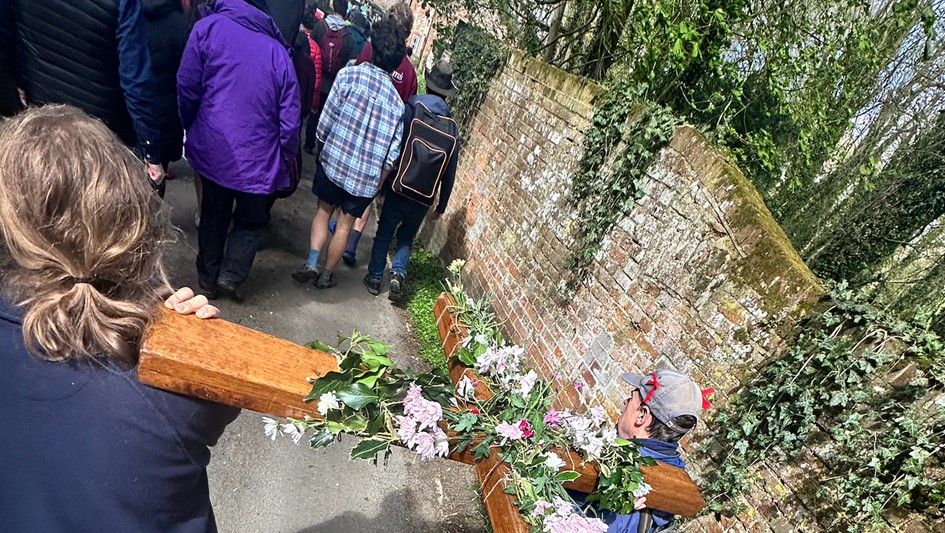
This year, for Easter, I walked 120 miles with a mixed group of pilgrims on ‘Northern Leg’ of Pilgrim Cross.
Real ecumenical spaces are vanishingly rare. LGBT+ friendly Christian spaces are rarer still. But what really struck me was how vital, lively, and uncommon it is to have a space to discuss matters of faith in a safe and low-stakes environment.
As a Quaker, coming from the lowest of low churches, Anglicans and Catholics have always looked so similar that I’ve been hard pressed to understand what difference could possibly have fomented the long history of disagreement between them.
It turns out, on our long journey to the ocean, that there’s plenty I didn’t know about my neighboring Christians. Despite having studied Theology, attended Catholic mass, having written a Masters Thesis on Laudato Si, and in all ways being about as interested and entangled in the comings and goings of Catholicism as a non-Catholic can be, there was plenty I saw which I didn’t understand.
I didn’t understand why the consecrated Eucharist must be removed from a Church hall before pilgrims could blow up their sleeping mats. I didn’t understand how a religious practice could be so focused on ritual and routine, and offer so little on teaching, or internal reflection. I talked at length with my fellow pilgrims about why we were walking a hundred miles to listen to a mass that was pre-scripted, and could be received anywhere?
The answer, I learned, is that there’s a pleasing comfort in the dependable ebb and flow of the familiar, that is highly compatible with spiritual contemplation. Indeed, as we settled into the big and small cycles of pilgrimage: waking, breaking camp, journey for a few hours at a time with a station (unscripted but intentional sharing of stories and reflections) at each rest spot, singing songs over tea and beer, and crawling back into a bed in our shabby church hall camps, I came to a deeper understanding of how these small repetitions can have a didactic quality of their own.
The first time I first did pilgrimage, ten years ago, I walked with Muslims. I was curious to learn, at the tender age of 22, that these people weren’t all austere, orthodox, perfect adherents to the rules of their faith like I had pictured in my mind. For the first time, through this lived experience, there are imperfect, lax, and naughty Muslims, just like I myself am a fairly ‘bad’ Christian at times. There is something about being in nature, exercising together, and facing these physical challenges as an ad hoc community, that destabilizes boundaries, and opens up space for new and deeper ways of knowing each other.
I had a similar experience on Northern Leg, but this time, I was exploring more nuanced and marginal distinctions between ecumenical Christians, as we attempted to bridge much smaller divides. Are we different because our doctrine is different, or are we different because we act/think/feel in different ways? And if we find we do in fact act, think, and feel in similar ways – what does this mean for our sense of ecumenical distance?
An eavesdropper on our long walks, especially in the rolling agricultural tundra of the fens, would hear explanatory parentheticals like: “The Church says x, but really we do y”, or “Our tradition says this, but if you talked to practitioners, they might tell you otherwise”, or “Most people seem to do it one way, but I personally think of it another way”.
This kind of thinking wrinkles our understanding of religious authority: Is it the leaders, big men, and post-schism manifestos that are the authoritative source for understanding identity? Or are we better served by turning to the lived religions, the embedded practices, and the internal faith-lives of individual practitioners? If we open up this space, it might turn out there is a lot more diversity, even within one’s own denomination, than we allow ourselves to see; the assumed hegemony of our own beliefs and practice serves to render meaningful and ubiquitous differences invisible.
As scholars or inquirers seeking to understand religion, it’s easy to turn to centralized doctrine, where things are written, codified, and disseminated as law. It’s much harder to attempt to understand people’s lived religions. For this, you’d have to do some kind of embedded anthropology. A 120 mile pilgrimage might do the trick!

